- Blog Details
Filling vs Crown: When Do You Need a Crown for Teeth After a Filling?
A filling is usually the first line of action dentists opt for if they identify decay or other minor problems with a patient’s teeth. It is an effective and non-invasive procedure that restores the tooth’s function and preserves the natural tissue.
There are instances when, despite a previous filling, a tooth will still require protection and support. Many people wonder why they are suggested a crown while returning for their regular appointment after having had a dental filling.
The concern usually revolves around the fact that a crown should not be necessary if the tooth has already been fixed. By knowing more about crowns and fillings, you can make better decisions regarding your oral health.
Both procedures serve different purposes, and they might be appropriate depending on specific circumstances. This guide explores the essential differences between these two treatments and tells when the second one would become a better option after the first one.
Difference between Filling and Crown
If you cannot choose which type of treatment will be better for your teeth, filling or a crown, then you need to know how they differ.
Filling is the procedure that is used in cases when tooth decay or tooth fracture occurs in case of wearing. It means that in such cases all defective parts of the tooth are cut out, and then the new one is put in their place.
The crown is something that is put over the whole upper part of the tooth. You should distinguish between filling and a crown because while the first procedure involves only a certain part of the tooth, the second one covers the whole surface of the tooth.
Another crucial difference is that the crown needs more tooth support.
Comparison between Filling and Crown
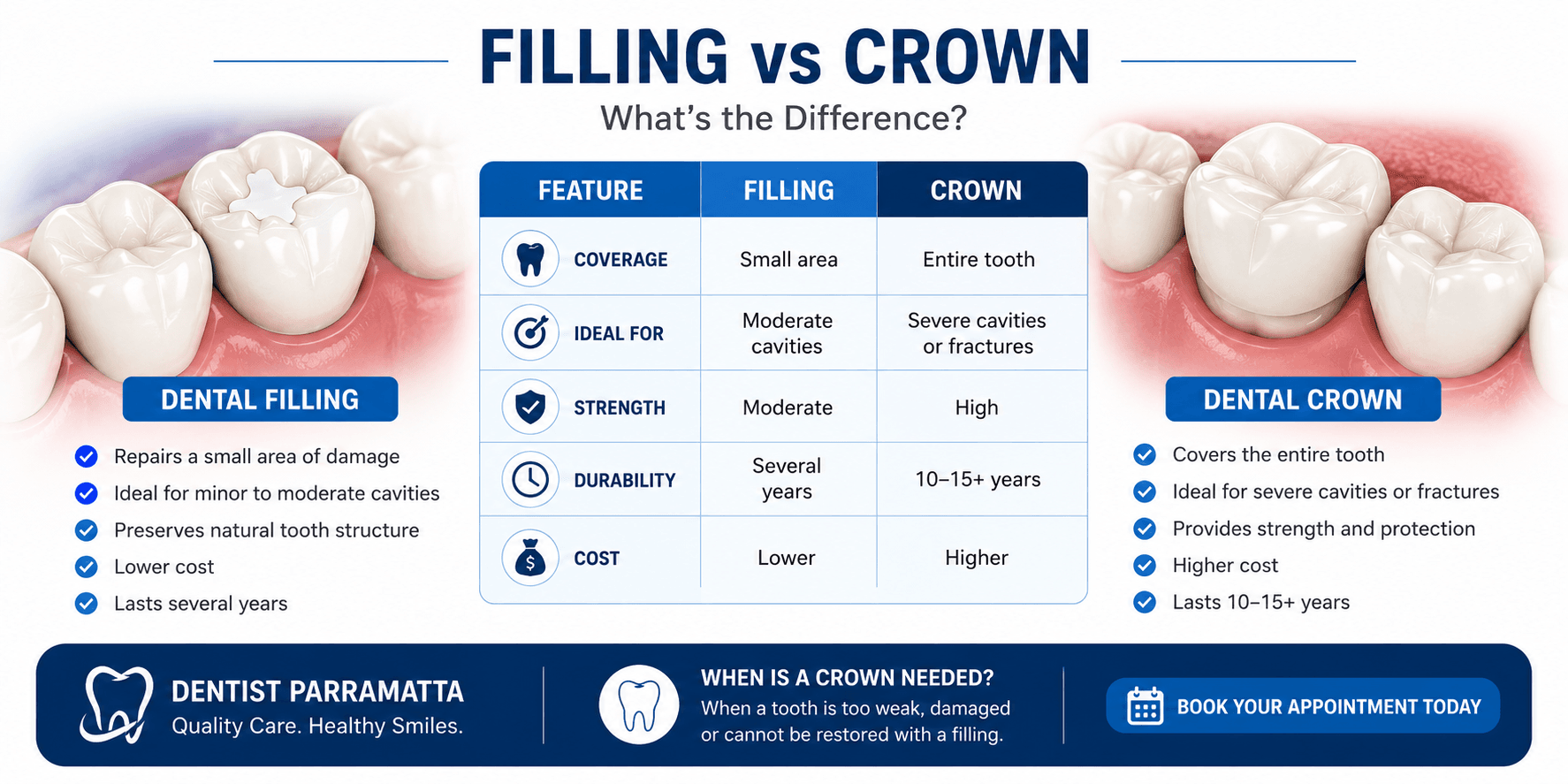
Below are some key differences between dental filling and crown that can help you understand when one procedure is more preferable than another.
Feature | Dental Filling | Dental Crown |
Coverage | Fixes a certain area of damage | Covering all the surfaces of the tooth |
Ideal for | Moderate cavities | Severe cavities and fractures |
Preservation of Tooth Structure | Natural tooth structure preserved more | Greater need for tooth shaping |
Level of Strength | For minor to moderate problems only | Maximum protection and strength |
Durability | Several years of service | Minimum 10–15 years |
Cost Factor | Lower costs | Higher costs initially |
Level of Protection | Moderate | High |
Crowns are needed when the tooth is not strong enough anymore to function properly.
When Is It Just A Filling That Can Restore The Tooth?
However, not all dental problems necessitate the installation of a tooth crown. Many times a filling will do an acceptable job of restoring your damaged tooth.
A dentist will opt to install a filling if:
- The hole in the tooth is neither too deep nor too big.
- The rest of the tooth still has strong and healthy parts.
- There are no serious cracks in the tooth that need to be dealt with.
- It can take the pressure that is exerted when you bite down.
- The damage is isolated to one spot.
These days there are some amazing tooth-colored filling materials out there that look great and work wonders. With proper care, they can last a lifetime, saving some of your natural tooth tissue along the way.
For those who have teeth with early or medium-level decay, a filling might be just the ticket.
When Will Your Dentist Recommend You Get A Crown For Your Teeth Following A Filling?
Dental crowns can be installed for those whose teeth have lost too much strength to be supported by fillings anymore.
The Filling Is Very Large
Another common reason for requiring a crown is when the tooth has a very large filling.
When the filling takes up a substantial amount of the tooth, there is no longer sufficient healthy tooth left in order to sustain daily chewing forces. In such a case, a crown helps to distribute the bite more effectively while protecting the tooth from breaking apart.
The Tooth Has Become Cracked
If a tooth develops a crack, then more protective material than just a filling may be required.
In these cases, the use of a crown helps to protect the teeth by covering the cracked area. This helps prevent further cracking that might ultimately destroy the tooth.
Root Canal Therapy
Following root canal therapy, teeth will lose their natural strength since they have lost part of their interior.
As such, crowns are routinely used following root canal treatments on molars and other teeth that are subject to significant force during chewing.
Repetitive Fillings
Occasionally, some teeth may need to have their fillings repeatedly replaced throughout the course of their lives.
As each filling procedure requires that more tooth enamel be removed, crowns become an increasingly likely necessity.
Choosing a Filling vs. a Crown
It isn’t just the size of a cavity that determines whether a patient gets a filling or a crown. Several key aspects are taken into consideration by dentists.
Amount of Remaining Teeth
The larger the amount of remaining healthy teeth, the easier it will be to perform a filling.
If there isn’t enough healthy tooth left after removing the decayed area, a crown may be necessary.
Location of the Tooth
Back teeth withstand much more biting force than front teeth.
Therefore, even a large filling might require a crown earlier than the same one in a front tooth due to the forces acting upon a back tooth during eating.
Chewing Forces and Tooth Grinding
Teeth grinders put extra stress on their teeth.
Due to this, a crown is a preferable choice in case of a filling because a large filling may not withstand such stresses.
Prognosis
A dentist strives to select such a method which will help solve both current and future problems.
Some situations demand crowns instead of fillings because they guarantee a good prognosis.
Why Are Crowns and Bridges Significant in Restorative Dentistry?
Crowns and Bridges are very significant treatments that are used nowadays in modern dentistry to restore badly damaged or missing teeth.
Crowns play a huge role since they help to preserve your damaged teeth by placing a protective cap that reinforces them from all sides. Usually, crowns are recommended after a serious restoration procedure such as filling or root canal, and, of course, after fracturing your teeth.
Bridges are designed specially to replace your missing teeth if you happen to have one or even several gaps among your teeth. Mostly, bridges consist of two dental crowns that keep them anchored on other teeth.
Why Would You Need a Crown Anyway?
One of the main misunderstandings regarding the need for a crown is that people think they should only get one if they feel pain in their tooth.
However, severely damaged teeth rarely show symptoms before cracking.
If you decide to skip a recommended crown, your tooth will remain susceptible to all of the following problems:
- Fracturing under pressure
- Structural damage
- Infection
- Root canal treatment
- Extraction
Usually, crowns are suggested as a preventative measure rather than an emergency procedure.
Consequences can be avoided with timely treatment.
Which Option Will Give More Protection in the Long Run?
It all comes down to the state of the tooth.
In the case when the damage is insignificant, and there is enough of the natural tooth left, a filling can give amazing long-term outcomes with minimal loss of natural tissues.
But if a tooth needs significant work, is cracked, weakened, or has had its nerve treated, then the most reliable solution will be a crown.
We are talking about not just repairing the tooth, but making sure that it serves for many years to come.
Conclusion
There cannot be a universal solution when it comes to making a choice between Filling vs Crown. In contemporary dentistry, each of these techniques serves its own purpose, but they are applied to various conditions.
The filling procedure is perfect for treating small areas of decay that require minor interventions. When it comes to severe cases of dental decay or when a patient has already had many fillings in his teeth, a crown becomes a necessity.
If your dentist has prescribed a crown after having a filling placed, then this is due to the need for more reliable protection. Timely application of appropriate treatment helps avoid serious consequences, preserves teeth and improves patients’ oral hygiene in the long run.
Frequently Asked Questions
Whereas a filling serves to restore a particular part of the tooth that has been damaged, a crown covers the entire tooth.
Sometimes you will require a crown if you have a large filling, the tooth is fractured, or the tooth has undergone root canal therapy in the past.
No. However, teeth in the back area benefit immensely from crowns after root canal treatment since they usually fracture easily.
With good oral hygiene and regular checkups with your dentist, dental crowns can stay for about 10 to 15 years, or even longer.
Yes, dental crowns are stronger than fillings since they cover the entire tooth structure.
Consequences could range from tooth fracturing, development of infections, root canal treatment and even tooth loss.
Related Post

Our Excellence and Awards!






Our Special Offer